Common Weeds Identification: Know What's Growing in Your Yard
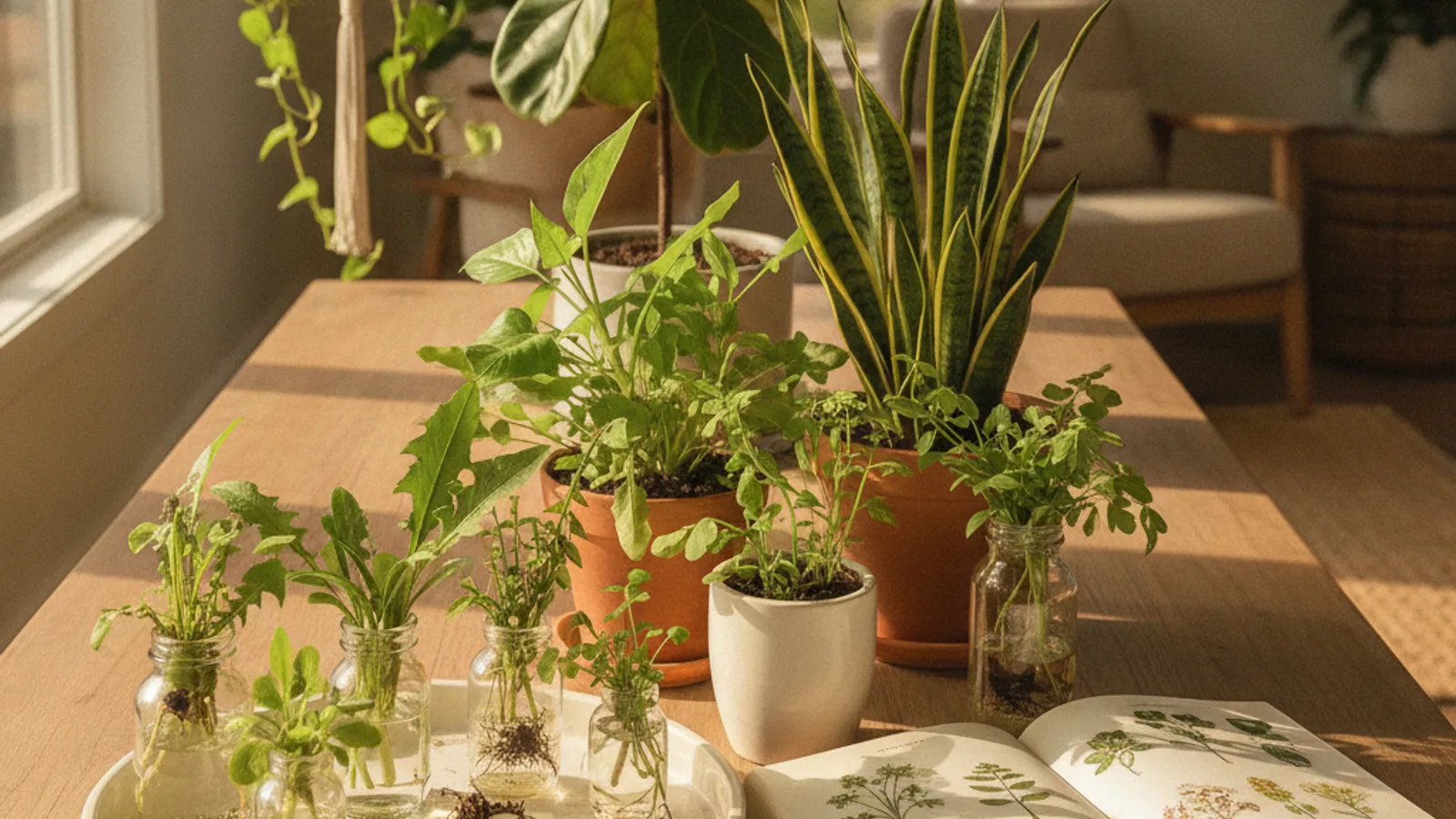
That mystery plant popping up in your lawn or garden bed, is it a weed, a wildflower, or something useful? Knowing what’s growing in your yard is the first step to managing it effectively. Some "weeds" are actually beneficial, while others need immediate removal. This guide covers 32 of the most common North American weeds with field marks, control methods, and which ones to consider keeping.
Jump to: Quick-reference table · Broadleaf weeds · Grassy weeds · Vining and creeping · Garden bed weeds · Control methods · Weed control toolkit · Beneficial "weeds"
Quick-Reference Identification Table
Use this table to narrow down what you’re looking at. Each weed links to its detailed entry below.
| Weed | Type | Key field-mark | Pull? |
|---|---|---|---|
| Dandelion | Broadleaf | Toothed rosette, yellow flower | Optional, edible |
| White Clover | Broadleaf | 3 round leaflets, white flower head | Keep, nitrogen fixer |
| Broadleaf Plantain | Broadleaf | Oval leaves, parallel veins | Optional |
| Creeping Charlie | Vining | Scalloped round leaves, minty smell | Pull, aggressive |
| Chickweed | Broadleaf | Tiny white star flowers, opposite leaves | Optional, edible |
| Purslane | Broadleaf | Fleshy paddle leaves, red stems | Keep, superfood |
| Henbit | Broadleaf | Square stem, scalloped leaves, purple flower | Optional |
| Wild Violet | Broadleaf | Heart-shaped leaves, purple/white flowers | Keep, pretty, edible |
| Yellow Woodsorrel | Broadleaf | Heart-shaped trifoliate leaves, yellow flowers | Optional, edible |
| Canada Thistle | Broadleaf | Spiny leaves, purple thistle flower | Pull, invasive |
| Common Mallow | Broadleaf | Round scalloped leaves, white-pink flowers | Optional, edible |
| Prickly Lettuce | Broadleaf | Tall stem, prickly midrib on lobed leaves | Pull |
| Crabgrass | Grassy | Star-pattern spread, light green | Pull, lawn invader |
| Nutsedge | Grassy | Triangular stem, fast upright growth | Pull aggressively |
| Annual Bluegrass | Grassy | Light green, seed heads even when mowed | Pull |
| Bermuda Grass (out of place) | Grassy | Spreads via stolons, fine blades | Depends on lawn type |
| Bindweed | Vining | Arrow-shaped leaves, trumpet flowers | Pull, invasive |
| Spotted Spurge | Mat-forming | Mat with milky sap, dark spot on leaves | Pull, sap irritates |
| Lamb’s Quarters | Broadleaf | Diamond leaves with whitish dust | Optional, edible |
| Pigweed/Amaranth | Broadleaf | Tall stem, dense flower spikes | Pull when young |
This table covers 20 of 32 weeds detailed below; the remaining 12 are described in the dedicated sections.
Broadleaf Weeds
These are the weeds with wide, flat leaves that stand out against narrow grass blades.
Dandelion (Taraxacum officinale)
The most recognizable weed in the world. Dandelions have deeply toothed, lance-shaped leaves forming a basal rosette close to the ground. Bright yellow flowers on hollow stems turn into distinctive white seed puffs. The deep taproot makes them hard to pull, if you leave any root behind, they'll regrow.
Fun fact: Dandelion greens are edible and nutritious, rich in vitamins A, C, and K. The flowers are used to make wine, and the roots can be roasted as a coffee substitute.
White Clover (Trifolium repens)
Recognizable by its three round leaflets, often with a lighter V-shaped marking on each. Produces round white (sometimes pinkish) flower heads. Spreads by creeping stolons.
Actually useful: Clover fixes nitrogen in the soil, feeds pollinators, and stays green in drought. Many people now intentionally add clover to their lawns as a "clover lawn" for its low-maintenance benefits.
Broadleaf Plantain (Plantago major)
Not related to the banana-like fruit! This plantain has wide, oval leaves with prominent parallel veins growing in a flat rosette. Produces tall, narrow flower spikes with tiny flowers. Very common in compacted soil and along paths.
Traditional use: Crushed plantain leaves have been used for centuries as a poultice for insect bites and minor wounds.
Creeping Charlie / Ground Ivy (Glechoma hederacea)
A mat-forming weed with scalloped, round to kidney-shaped leaves on square stems. Has a minty smell when crushed. Small purple flowers appear in spring. Spreads aggressively by runners and is one of the hardest weeds to eliminate.
Chickweed (Stellaria media)
A low-growing winter annual with small, opposite oval leaves and tiny white star-shaped flowers. Each petal is so deeply notched it looks like 10 petals instead of 5. Forms dense mats in cool, moist conditions. Edible in salads.
Purslane (Portulaca oleracea)
A summer annual with thick, fleshy, paddle-shaped leaves on reddish stems that sprawl along the ground. Tiny yellow flowers. Looks succulent-like.
Superfood weed: Purslane is one of the most nutritious "weeds", rich in omega-3 fatty acids, vitamins A and C, and minerals. It’s cultivated as a vegetable in many cultures.
Henbit (Lamium amplexicaule)
Often confused with purple deadnettle. Henbit has square stems (a mint family marker), scalloped round leaves that clasp the stem directly without petioles, and small purple-pink tubular flowers in early spring. Most visible March-May, then fades by summer.
Edible (mildly minty taste); important early-season pollinator food.
Wild Violet (Viola sororia)
Heart-shaped leaves on long stems, with delicate purple, white, or yellow five-petaled flowers in spring. Forms expanding clumps via rhizomes. Often considered a weed in turf because herbicides struggle to control it, the waxy leaves shed sprays.
Many gardeners now keep violets as a pollinator-friendly groundcover. Flowers and young leaves are edible (high in vitamin C).
Yellow Woodsorrel / Oxalis (Oxalis stricta)
Often mistaken for clover but has three heart-shaped leaflets (clover’s are round) and small five-petaled yellow flowers. Produces upright seedpods that explode when ripe, scattering seeds 5+ feet. Common in gardens, lawns, and pavement cracks.
Leaves have a pleasant lemony-sour taste, the oxalic acid is harmless in small amounts.
Canada Thistle (Cirsium arvense)
One of the most aggressive perennial weeds in temperate climates. Spiny, deeply lobed leaves, multiple branching upright stems 2-4 ft tall, clusters of small purple thistle flowers. Spreads via deep horizontal roots that send up new shoots, pulling tops doesn’t kill it.
Federally listed as a noxious weed in most US states. Persistent removal or selective herbicide is required.
Common Mallow (Malva neglecta)
Low-growing biennial with round, lobed, scalloped leaves on long petioles, looking somewhat like geranium leaves. Small white-to-pinkish 5-petaled flowers cluster at leaf bases. Long taproot.
Edible (mucilaginous like okra) and traditionally used as a medicinal herb. Tolerates poor soil and neglect, which is why it shows up in driveway cracks.
Prickly Lettuce (Lactuca serriola)
Tall (3-7 ft) annual with lobed leaves whose midrib has a row of prickles on the underside. Leaves twist to vertical orientation in sun (it’s called "compass plant" for this reason). Yellow dandelion-like flowers in branching panicles. Stems exude milky latex when broken.
Wild ancestor of cultivated lettuce. Pull when young; mature plants are tough and reseed prolifically.
Common Ragweed (Ambrosia artemisiifolia)
Cause of late-summer "hay fever" allergies. Annual with deeply dissected, fern-like leaves. Stems often reddish, growing 1-4 ft tall. Inconspicuous green flower spikes release massive amounts of wind-pollinated pollen August-October.
Pull before flowering. Often confused with the unrelated (and harmless) Mugwort.
Common Mullein (Verbascum thapsus)
Biennial. First year: large, fuzzy gray-green basal rosette. Second year: dramatic 5-7 ft tall flowering stalk with yellow flowers. Often grows in disturbed soil and waste areas.
Used in traditional herbalism (the leaves were called "cowboy toilet paper" for their softness). Many gardeners leave them for the architectural effect.
Stinging Nettle (Urtica dioica)
Heart-shaped opposite leaves with toothed edges, covered in fine stinging hairs that cause an itchy welt on contact. Square stems. Small green flower clusters in leaf axils. Common in moist, fertile soil, often along streams and forest edges.
Cooked nettles are highly nutritious (the cooking deactivates the sting). Wear gloves to harvest or remove.
Found a weed you can't identify?
Snap a photo and get instant identification with our free AI tool.
Grassy Weeds
These weeds look like grass but grow differently than your lawn grass. They’re harder to spot but can take over quickly.
Crabgrass (Digitaria spp.)
The bane of lawn care enthusiasts. Crabgrass is a summer annual that spreads in a star pattern from a central point, growing low and flat. Blades are wider and lighter green than most lawn grasses. It thrives in hot, thin areas of the lawn and produces thousands of seeds before dying in fall.
Control: Pre-emergent herbicide applied in early spring (before soil reaches 55°F for 4 days running) is the most effective method. Once visible, post-emergent herbicides containing quinclorac work but only on young plants.
Nutsedge (Cyperus spp.)
Often mistaken for grass, but nutsedge is actually a sedge, identified by its triangular stem (roll it between your fingers) and rapid, upright growth that outpaces surrounding grass. Yellow nutsedge and purple nutsedge are the two main types. Extremely difficult to control due to underground tubers.
Control: Selective herbicides containing sulfentrazone or halosulfuron-methyl. Hand-pulling almost always fails, the broken tubers regenerate.
Annual Bluegrass (Poa annua)
A light green grass that produces seed heads even at very short mowing heights. It’s a winter annual that dies in summer heat, leaving bare patches. The seed heads give it away, white, fluffy clusters visible even in closely mowed lawns.
Bermuda Grass (out of place)
Bermuda grass is intentional turf in the South but a hard-to-kill invader in northern lawns and garden beds. Spreads via stolons (above ground) and rhizomes (below), with fine blades and aggressive growth. Once established in a garden bed, it requires repeated glyphosate applications or solarization.
Goosegrass (Eleusine indica)
Looks similar to crabgrass but identifiable by the silvery white center at the base where the leaves meet. Forms a flatter, more compact mat. Very heat-tolerant; appears in compacted, thin areas after crabgrass season.
Foxtail (Setaria spp.)
Annual grass with distinctive fluffy "fox tail" seed heads in late summer. Three main species: green, yellow, and giant foxtail. Seeds are bristly and can lodge in pet paws/ears or in clothing. Pull before seed heads form.
Vining and Mat-Forming Weeds
Field Bindweed (Convolvulus arvensis)
One of the most persistent weeds in agriculture and home gardens. Arrow-shaped leaves, twining stems that climb plants and structures, white-to-pink trumpet-shaped flowers similar to morning glory. Roots can extend 20+ feet deep, making mechanical control nearly impossible.
Control: Repeated removal of top growth weakens the plant over years. Glyphosate is the most effective chemical control (when actively growing).
Spotted Spurge (Euphorbia maculata)
Low, mat-forming summer annual with small opposite oval leaves often with a dark spot in the center. Stems exude milky white sap when broken, this sap can cause skin irritation and is toxic to pets if eaten in quantity. Tolerates extreme heat and dry soil.
Japanese Stiltgrass (Microstegium vimineum)
Aggressive invasive annual grass spreading rapidly across the eastern US. Lance-shaped leaves with a silvery midrib stripe, sprawling sparse stems. Out-competes native woodland plants. Pull before flowering in late summer.
Poison Ivy (Toxicodendron radicans)
"Leaves of three, let it be." Three almond-shaped leaflets with the middle one on a longer stem. Leaves are reddish in spring, green in summer, brilliant red/orange in fall. Grows as ground cover, climbing vine, or shrub. Causes contact dermatitis in 80% of people.
See our dedicated Poison Ivy Identification Guide for safer removal advice.
Garden Bed Weeds
Lamb’s Quarters (Chenopodium album)
Tall, upright annual with diamond-shaped leaves dusted with a whitish coating on the undersides (looks like flour). Common in disturbed soil. Edible, tastes like spinach when young leaves are cooked.
Pigweed / Amaranth (Amaranthus spp.)
Fast-growing summer annual with oval to lance-shaped leaves and dense terminal flower spikes. Some species (Palmer amaranth, waterhemp) are major agricultural pests with herbicide resistance. Seeds are edible (grain amaranth is a cultivated relative).
Pull when young, mature plants produce 100,000+ seeds.
Carpetweed (Mollugo verticillata)
Mat-forming summer annual with whorled leaves in groups of 5-6 at each node, forming flat green carpets in disturbed soil. Tiny white flowers. Often confused with chickweed but the whorled leaf arrangement is distinct.
Common Groundsel (Senecio vulgaris)
Annual or biennial with deeply lobed leaves and clusters of small yellow flowers (no ray petals, just yellow disk flowers in cup-like bracts). Common in cool-season vegetable beds. Toxic to livestock.
Hairy Bittercress (Cardamine hirsuta)
Small winter annual common in nursery containers and garden beds. Pinnate leaves with rounded leaflets in a basal rosette. Tiny white flowers in early spring quickly produce seed pods that explode when touched, scattering seeds several feet.
Easily pulled when young; the explosive seedpods make ignored plants spread rapidly.
How to Control Weeds (Without Herbicides First)
Control depends on weed type and tolerance level. Here’s the method ranking most lawn-care professionals follow:
1. Hand-pulling (best for small infestations)
Pull weeds when soil is moist, the entire root usually comes out. Dandelions, plantain, and mallow have taproots; use a forked dandelion digger tool to leverage the root out without breaking it. For larger lawns, a stand-up weed puller eliminates bending entirely. For nutsedge and bindweed, hand-pulling alone fails, broken tubers/rhizomes regenerate.
2. Mulching (prevention)
3 inches of mulch in garden beds blocks 90% of weed germination. Wood chips, shredded leaves, or straw all work. For persistent weed pressure under the mulch, lay landscape fabric first, it allows water through while blocking light to seeds. Refresh mulch layer annually.
3. Improve lawn density (prevention)
A thick, healthy lawn out-competes most weeds. Overseed thin areas in fall, mow at 3–3.5 inches (taller grass shades out crabgrass seedlings), and fertilize correctly for your turf type.
4. Pre-emergent herbicide (annual weeds)
Applied to soil in early spring (crabgrass) or early fall (winter annuals like chickweed and bittercress) to prevent seed germination. Scotts Halts Crabgrass Preventer is the most widely used spring pre-emergent. Corn gluten meal is an organic option but only ~60% effective.
5. Post-emergent herbicide (spot treatment)
2,4-D and dicamba selective broadleaf herbicides kill dandelions, clover, and plantain without damaging grass. Glyphosate concentrate kills everything (use carefully around desirable plants). Always read labels, some herbicides damage trees and shrubs through root uptake.
6. Solarization (long-term clearing)
Cover problem areas with clear plastic sheeting for 6–8 weeks during peak summer. Heat sterilizes the top inch of soil, killing seeds and roots. Effective for clearing beds before replanting.
Weed Control Product Toolkit
These are the tools and products that cover the most common weed control scenarios, from organic manual removal to chemical spot treatment:
- Fiskars Stand-Up Weed Puller, removes taprooted weeds (dandelion, plantain, thistle) with a foot-press and lever action; no bending, no hand strain
- CobraHead Weeder & Cultivator, curved steel blade that works under the crown of weeds and loosens soil around roots; preferred by serious gardeners
- Ortho GroundClear Weed & Grass Killer, fast-acting non-selective formula for gravel paths, driveways, and bare soil clearance where you don't want any regrowth
- Spectracide Weed Stop for Lawns, selective formula kills 460+ broadleaf weeds in established turf without harming grass; covers up to 10,000 sq ft
- DeWitt Pro 5 Landscape Fabric, heavy-duty woven ground cover for garden beds; blocks weed germination while allowing water and air through; 3 oz. weight holds up for years under mulch
- Flexrake Hula-Ho Stirrup Hoe, oscillating head cuts on both push and pull stroke; the fastest manual tool for clearing young weed seedlings from garden beds on a regular basis
Weeds Worth Keeping
Some "weeds" are actively beneficial. Consider keeping or even encouraging:
- White clover, nitrogen fixer; many people now intentionally seed clover into lawns ("clover lawn" trend)
- Dandelions, deep taproots break up compaction; greens are edible and flowers feed early bees
- Purslane, one of the most nutritious leafy greens; cultivated as a vegetable in Mexico, Greece, Turkey
- Wild violets, pretty, edible flowers, support pollinators
- Yellow woodsorrel, lemony edible leaves; competes minimally with turf
- Stinging nettle, cooked leaves are highly nutritious; also a host plant for several butterfly species
To Pull or Not to Pull?
Consider keeping:
- White clover (nitrogen fixer, pollinator food)
- Dandelions (edible, deep roots break up compacted soil)
- Purslane (nutritious, edible ground cover)
- Violets (pretty, edible flowers, pollinator-friendly)
Remove promptly:
- Poison ivy (see our poison ivy identification guide)
- Bindweed (invasive, chokes other plants)
- Nutsedge (aggressive, hard to control once established)
- Crabgrass (takes over lawn areas)
Frequently Asked Questions
How do I identify weeds in my lawn?
Look at leaf shape, growth pattern, and flowers. The fastest method is to snap a photo with our AI plant identifier for instant results.
What are the most common lawn weeds?
Dandelions, crabgrass, white clover, chickweed, plantain, creeping Charlie, nutsedge, and spurge are among the most common across North America.
Are any common weeds edible or useful?
Yes! Dandelion greens, purslane, chickweed, and lamb's quarters are all edible. White clover fixes nitrogen in soil. Plantain has traditional medicinal uses.
Related reading: How to Identify Poison Ivy · Tree Identification by Leaf · Flowering Plant Identification
Related Articles
Early Spring Weed Identification Identify the 6 weeds that appear first in spring. How to Identify Poison Ivy Master the art of spotting poison ivy and its lookalikes. How to Identify Mushrooms A beginner's guide to mushroom identification.- Know your plants 🌿 -
Upload a Photo