Best Humidifiers for Plants 2026: Ultrasonic, Evaporative & Warm Mist Compared
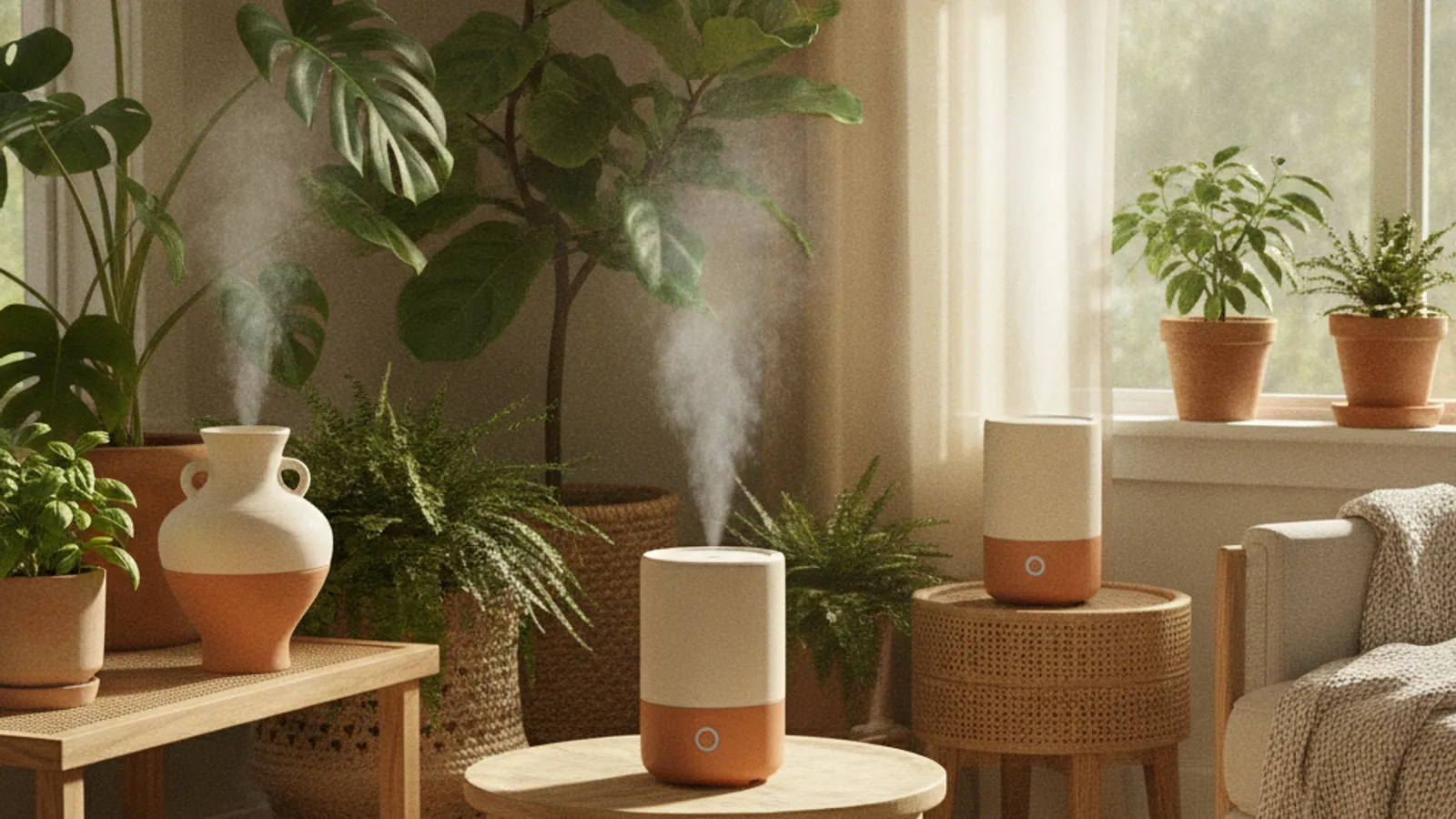
Low humidity is the silent killer of tropical houseplants. While the average US home sits at 20–35% relative humidity (RH) in winter, the range of a desert climate, calatheas, orchids, ferns, alocasias, and most other tropicals need 50–70% RH to thrive. The visible symptoms (leaf edges turning brown and crisp, curling, yellowing) show up weeks after the damage is done, and no amount of additional watering fixes the root cause. A humidifier targeted at the plant area solves the problem directly and cheaply.
The technology choice matters for plant owners specifically. Ultrasonic humidifiers produce cool mist efficiently and quietly, but emit white mineral dust from tap water that can clog leaf pores over time, a real concern for delicate ferns and calatheas. Evaporative humidifiers use a wick filter that traps minerals before adding moisture to the air, producing no white dust regardless of water quality. Warm mist units boil water, eliminating bacteria and minerals, but draw more electricity. This guide covers eight humidifiers across every type, budget, and room size, including a nano option for a single plant shelf and a whole-room unit for a dedicated plant room.
At a Glance
 Levoit Classic300S Ultrasonic Smart Top Fill...
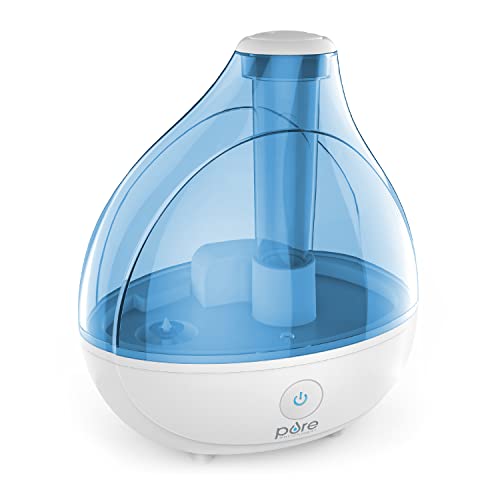 Pure Enrichment MistAire Ultrasonic Cool Mist...
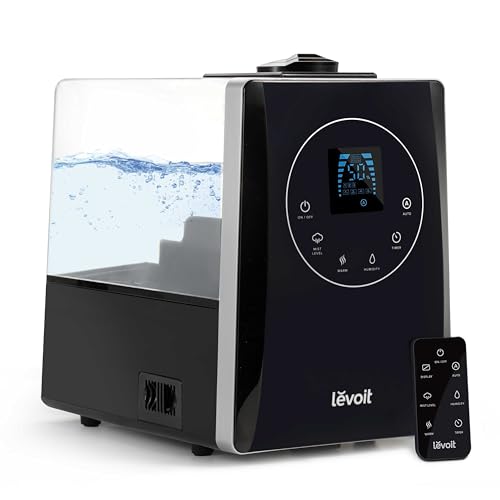 Levoit LV600HH 6L Warm&Cool Mist Humidifier for...
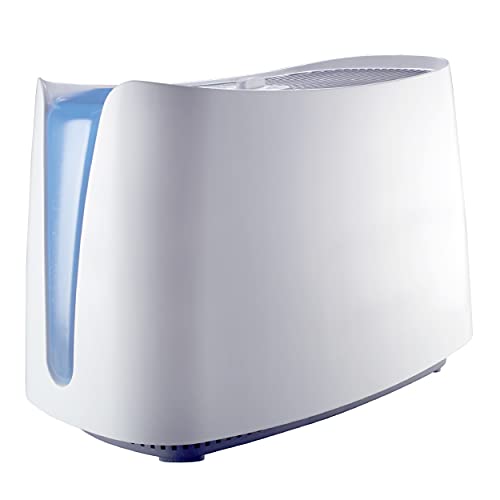 Honeywell Germ Free Cool Mist Humidifier, Medium Room,...
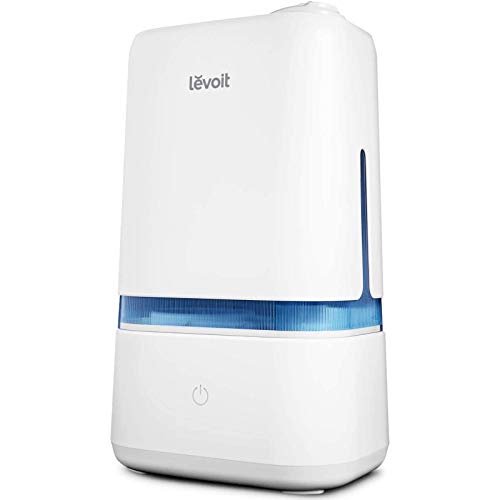 LEVOIT 4L Humidifiers for Bedroom Large Room &...
 Vicks Warm Mist Humidifier Filter-Free 1-Gal Tank,...
Product images and titles from Amazon. As an Amazon Associate we earn from qualifying purchases.
Quick Picks: Best Humidifiers for Plants 2026
| Use Case | Top Pick | Why It Wins | Est. Price |
|---|---|---|---|
| Best overall | Levoit Classic 300S | 2.4L top-fill, smart auto-humidity, ultra-quiet 26dB, essential oil tray | $55–75 |
| Best budget | Pure Enrichment MistAire | 1.5L, quiet, optional nightlight, auto-off, under $35 | $28–38 |
| Best large room (6L) | Levoit LV600HH | 6L, dual warm/cool mist, built-in hygrostat, 36-hour runtime | $65–90 |
| Best evaporative (no white dust) | Honeywell HCM350 | 1.1 gal, wicking filter traps minerals, self-regulating, quietest type | $35–55 |
| Best for orchids & ferns | Levoit Classic 200 | 2.4L, 26dB whisper-quiet, directional nozzle for targeted high-humidity zones | $38–52 |
| Best warm mist | Vicks V745A | 1.2 gal, boils water (bacteria-free), ideal for cold plant rooms in winter | $32–48 |
| Best nano/USB | Mini USB ultrasonic humidifier | 250–500ml, USB-powered, fits on a plant shelf or propagation station | $12–20 |
| Best whole-room | AIRCARE MA1201 Console | 3.6 gal evaporative, covers 3,600 sq ft, digital humidistat, no white dust | $80–120 |
Best Overall: Levoit Classic 300S
The Levoit Classic 300S is the houseplant humidifier that earns the most consistent recommendations from plant collectors, and for good reason. The top-fill design means you pour water directly into the tank opening from the top without removing the base or turning the unit upside down, which is the most common frustration point with budget ultrasonic humidifiers. Combined with a 2.4L tank that runs 24–40 hours at the low-to-medium setting, the refill cadence is manageable for most households.
The smart auto-humidity mode is the genuinely useful differentiator. Set your target humidity (50%, 60%, or 70%, the right ranges for most tropicals and orchids respectively) and the 300S uses its built-in hygrosensor to cycle on and off to maintain that exact level. This prevents the common mistake of running a humidifier at maximum output continuously, which can push humidity above 80% and encourage mold or fungal issues in plant soil. The companion app (Vesync) logs humidity readings over time, which lets you verify that your calatheas or ferns are actually getting the 60–70% they need.
Levoit Classic 300S (2.4L, Smart Ultrasonic)
The 360-degree rotating nozzle lets you direct mist output toward specific plants or away from electronics. For a plant shelf arrangement with calatheas and ferns, angle the nozzle at shelf level rather than upward, mist disperses sideways through the plant canopy more evenly than a column rising vertically. The essential oil tray adds fragrance capability for the space as a bonus, though skip essential oils in the water tank itself (use only the dedicated tray) to protect the ultrasonic plate from oil residue.
Pros
- Top-fill design, fastest, most convenient daily refilling
- Auto-humidity mode maintains your target % without constant adjustment
- Ultra-quiet 26dB, runs in a bedroom without disturbing sleep
- App logs humidity history to verify plant conditions over time
Cons
- Ultrasonic type, use distilled water or expect white mineral dust on leaves
- Mid-range price ($55–75) vs. simpler ultrasonic options at $30–40
Best Budget: Pure Enrichment MistAire
The Pure Enrichment MistAire is the most widely recommended entry-level plant humidifier, and it earns that reputation by being genuinely good at the one thing it does: quietly adding moisture to a small-to-medium room for 16–25 hours on a single 1.5L fill. There is no app, no smart humidity sensing, and no warm mist, just a reliable ultrasonic unit that runs below $35, cleans easily, and lasts 2–3 years of daily use without issues.
The 360-degree rotating nozzle is a practical feature at this price point, giving you the ability to direct mist output precisely. For a plant corner arrangement, position the MistAire 2–3 feet from your humidity-loving plants and angle the nozzle slightly away from direct leaf contact. The auto-off when the tank empties is a safety feature that prevents the motor from burning out if you forget a refill, a more important consideration than it sounds for humidifiers running overnight or during a workday.
Pure Enrichment MistAire (1.5L, Cool Mist Ultrasonic)
The MistAire covers spaces up to 175 sq ft effectively, enough for a bedroom, home office, or dedicated plant corner. At 1.5L, you will refill it every 1–2 days if running 8+ hours daily, which is a manageable routine for most plant owners. The optional night light cycles through colors and can be turned off entirely if you prefer complete darkness for light-sensitive plants. At under $35, buying two MistAires to cover separate plant areas is still cheaper than one mid-range smart humidifier.
Pros
- Under $35, lowest cost entry point for a reliable ultrasonic humidifier
- Simple to operate, no app, no programming, just fill and run
- Auto-off safety feature protects the motor when tank empties
- Widely available replacement parts and wicking pads
Cons
- 1.5L tank requires daily refilling when running 8+ hours continuously
- No auto-humidity control, you set mist output manually
Best Large Room (6L): Levoit LV600HH
The Levoit LV600HH is the right choice for a dedicated plant room, a large living room collection, or anyone who wants to run a humidifier all day without refilling it. The 6L tank runs 36+ hours at medium output and up to 60 hours at the lowest setting, meaning a single evening fill lasts through the following day and night without intervention. For calatheas, bird of paradise, and large monstera collections that need sustained 60–70% humidity across a significant floor area, the LV600HH is the workhorse pick.
The dual warm and cool mist option is a real differentiator. Cool mist works for most conditions; warm mist is the better choice in a cold plant room (under 65°F) where cool mist would slightly chill the air further and stress tropical plants. The built-in humidistat pairs with auto-mode to cycle the unit on and off to maintain your target humidity exactly, without the Vesync app required by the 300S, which makes it simpler to configure from the physical controls.
Levoit LV600HH (6L, Dual Warm & Cool Mist)
The LV600HH includes a remote control, a practical addition for a plant room where the humidifier is placed at floor level among large specimen plants and you don't want to reach across a collection to adjust settings. The sleep mode dims the LED display and runs at the lowest whisper setting; pair it with the timer function (set to turn on 1 hour before you enter the plant room) to wake up to optimal humidity rather than waiting for it to build from ambient levels.
Pros
- 6L tank, one fill every 1.5–2.5 days at normal output, reduces refill chore
- Dual warm/cool mist, optimal for cold plant rooms in winter
- Built-in humidistat maintains target % without requiring an app
- Remote control, adjust settings without reaching into your plant collection
Cons
- Ultrasonic type, white mineral dust accumulates on leaves and surfaces without distilled water
- Larger footprint than the 300S, needs floor or table space in the plant area
Best Evaporative (No White Dust): Honeywell HCM350
Evaporative humidifiers work differently from ultrasonic units: rather than atomizing water droplets, they draw dry air through a wet wicking filter, evaporating only pure water vapor into the room while minerals stay trapped in the filter. The result is zero white dust on plant leaves, furniture, or electronics, a significant practical advantage over ultrasonic types when running near calatheas, ferns, or any plant with textured or waxy leaves where white residue accumulates and clogs stomata over weeks.
The Honeywell HCM350 holds 1.1 gallons (approximately 4.2L) and covers up to 400 sq ft. The wicking filter (HAC-504V) needs replacement every 1–2 months, costing roughly $8–12, which is the main ongoing cost compared to ultrasonic types. The trade-off is real: no white dust, natural humidity regulation (the unit self-regulates as room humidity approaches saturation, unlike ultrasonic units that keep misting regardless), and whisper-quiet operation with no ultrasonic vibration noise. For fern and maidenhair collections that demand 65–75% RH without mineral contamination, the HCM350 is the cleaner technical choice.
Honeywell HCM350 Cool Moisture Evaporative Humidifier
The evaporative mechanism's self-regulating property matters specifically for plant care. As room humidity approaches the target level, the evaporation rate slows naturally, the unit can't over-humidify a space the way an ultrasonic running at high output can. This built-in governor makes the HCM350 safer to run in enclosed spaces (near a grow tent or in a small bathroom plant corner) without risking the 85–90% RH that encourages mold on soil surfaces and leaf undersides.
Pros
- Zero white dust, safe for delicate ferns, calatheas, and orchids even with tap water
- Self-regulating, won't over-humidify enclosed plant areas
- Antimicrobial wick treatment inhibits mold and bacteria growth in the filter
- Quiet operation, no ultrasonic vibration hum
Cons
- Replacement filters ($8–12/ea) add ongoing cost vs. no-filter ultrasonic types
- Cannot produce warm mist, cool only, which may slightly chill air in cold rooms
Best for Orchids & Ferns: Levoit Classic 200
The Levoit Classic 200 is the choice for growers who need a reliable, whisper-quiet humidifier for a dedicated orchid windowsill, fern shelf, or tropical plant station where noise is a concern and room coverage is modest. At 26dB on its lowest setting, quieter than a library, it operates effectively alongside sleeping areas, home offices, and media rooms without introducing audible background hum.
The 2.4L tank runs 24 hours at the medium mist setting, aligning naturally with a daily morning refill ritual for dedicated plant owners. The directional nozzle rotates 360 degrees, which allows precise targeting of a specific plant shelf or window arrangement at a set humidity output. For orchids that demand 65–75% RH but dry out quickly on a sunny south-facing windowsill, place the Classic 200 at shelf level pointing toward the orchid collection and let it run 6–8 hours during peak daylight when evaporation is highest.
Levoit Classic 200 (2.4L, Ultra-Quiet Cool Mist)
The Classic 200 does not include a humidistat or app connectivity, it runs at whichever output level you select manually. For most orchid and fern applications, this is fine: run at medium output for 6–8 hours on a timer, check the tray humidity with a small hygrometer, and adjust output based on the reading. Use distilled water to avoid the white mineral dust issue on orchid leaves, which can block the light absorption that is already a challenge on humid windowsills with limited direct sun.
Pros
- 26dB, genuinely whisper-quiet, ideal for bedroom plant setups
- 2.4L capacity reduces refill frequency vs. 1.5L budget options
- Affordable price point ($38–52) for the quiet performance tier
- Essential oil tray built-in (use tray only, not the water tank)
Cons
- No built-in hygrostat, requires a separate hygrometer to monitor humidity
- Ultrasonic type, use distilled water around orchid leaves and fern fronds
Best Warm Mist: Vicks V745A
Warm mist humidifiers boil water before releasing it as steam, which eliminates mineral content, mold spores, and bacteria from the output entirely. For plant owners in cold climates where a plant room or spare bedroom drops below 60°F in winter, the temperature range where tropical plants begin to stress, a warm mist unit adds a small but meaningful heat contribution to the immediate plant environment while humidifying.
The Vicks V745A is a dependable 1.2-gallon warm mist unit that runs 12–24 hours per fill depending on setting. The boiling mechanism means the output is bacteria-free and produces no white dust, making it a cleaner choice than ultrasonic units around delicate plant collections. The main operating cost is electricity: warm mist humidifiers use approximately 200–300W (similar to a small incandescent light bulb running continuously) versus the 20–50W of ultrasonic units. Running it 8 hours daily adds roughly $3–6/month to an electric bill at average US rates, a minor cost for most plant owners but worth noting for continuous large-space operation.
Vicks V745A (1.2 Gallon Warm Mist Humidifier)
The Vicks V745A includes a medicine/scent cup at the steam output for VapoPads, which adds mentholated vapor to the output. For plant use, omit the pads, menthol and eucalyptus oils can be phytotoxic to some sensitive plants at high concentrations in an enclosed space. Run the unit steam-only with clean water for plant applications. The V745A cleans easily with a standard white vinegar soak of the tank (monthly maintenance to prevent mineral scale on the heating element), the same descaling routine as an espresso machine.
Pros
- Boiling eliminates bacteria and minerals, cleanest mist output of any type
- Adds slight warmth, ideal for cold plant rooms in winter
- No white dust on plant leaves or furniture
- Affordable price ($32–48) for bacteria-free warm mist
Cons
- Higher electricity draw (200–300W) vs. ultrasonic (20–50W)
- Hot steam output, keep 12+ inches from plant leaves and away from children
Best Nano/USB: Mini Ultrasonic Humidifier
For a single plant shelf, propagation station, or small grow tent, a mini USB ultrasonic humidifier with a 250–500ml tank is the most practical solution. These units are the size of a coffee mug, run off any USB port or power adapter, and cost $12–20, less than a bag of perlite. The 250–500ml tank runs 4–8 hours depending on output, which is ideal when paired with a simple timer outlet set to run 6 hours during daylight.
The key differentiator among mini humidifiers is nozzle design. Look for a unit with a directional nozzle or flexible tube output rather than a fixed upward-pointing vent, directional nozzles let you aim mist toward the plant canopy at shelf level, which is where humidity matters for leaf transpiration, rather than having mist rise straight up into room air. The flexible-arm models from multiple brands allow you to position the mist output precisely between plant stems on a crowded shelf without getting water on the soil surface (which can invite fungus gnats).
Mini USB Ultrasonic Humidifier (250–500ml)
These mini units work best as a complement to a primary room humidifier rather than a standalone solution. Run a Levoit Classic 300S or Pure Enrichment MistAire to raise the whole-room baseline to 45–50%, then use a nano unit targeted at the specific shelf with your most humidity-demanding plants (calatheas, maidenhair ferns, orchids) to push that microzone to 65–75% without over-humidifying the whole room. This targeted approach is more energy-efficient and achieves better humidity precision than trying to raise a large room to 70%+ with a single unit.
Pros
- Under $20, lowest cost entry point, buy several for multiple plant stations
- USB-powered, runs from any phone charger or USB hub, no outlet needed
- Compact footprint fits on crowded plant shelves without taking pot space
- Directional nozzle allows precise targeting of plant canopy humidity
Cons
- 250–500ml tank requires refilling every 4–8 hours, high maintenance for full-day use
- Only effective in a small zone (2–4 sq ft); not a whole-room solution
Best Whole-Room: AIRCARE MA1201 Console
For a dedicated plant room, sunroom, or large open-plan living area with a significant plant collection, the AIRCARE MA1201 is the right-sized solution. The 3.6-gallon (13.6L) tank runs 24–36 hours between fills and covers up to 3,600 square feet, large enough to humidify an entire floor of a house. As an evaporative console humidifier, it produces zero white dust regardless of water source, making it the most practical choice for large plant collections where dusting mineral residue off dozens of leaves is impractical.
The digital humidistat maintains your target humidity automatically, cycling the fan on and off to hold a set percentage. For a plant room targeting 60–65% RH, set the MA1201 and walk away, the unit self-regulates and the digital display shows real-time humidity. The main maintenance task is replacing the wick filter (ES12 filter, approximately $15–20, every 1–2 months depending on water hardness), but at the coverage and capacity this unit provides, that filter cost is well below the comparable cost of running multiple smaller ultrasonic units.
AIRCARE MA1201 Whole-Room Console Humidifier
The MA1201's output is powerful enough to raise a 600 sq ft plant room from 25% to 60% RH within 3–4 hours of operation, a speed that smaller desktop units cannot match. For seasonal setup in late autumn when forced-air heating drops humidity sharply, running the MA1201 on its first full day at maximum output to build baseline humidity, then switching to auto-mode to maintain it, is the most efficient use pattern. The castors on the base allow it to be repositioned within a room without lifting.
Pros
- 3,600 sq ft coverage, the only whole-house solution in this guide
- Evaporative type, zero white dust, self-regulating humidity ceiling
- 3.6-gallon tank reduces daily refill chore for large plant collections
- Digital humidistat, set-and-forget maintenance of target humidity
Cons
- Higher upfront cost ($80–120) and floor footprint vs. desktop units
- ES12 filter replacement adds $15–20 per 1–2 months in ongoing cost
Humidifier Type Comparison for Plant Use
| Feature | Ultrasonic (cool) | Evaporative | Warm Mist |
|---|---|---|---|
| White dust on leaves | Yes (tap water) / None (distilled) | None, wicking filter traps minerals | None, boiling removes minerals |
| Electricity use | Low (20–50W) | Low–Medium (15–30W fan) | High (200–400W heater) |
| Bacteria in output | Possible if tank not cleaned weekly | Reduced by antimicrobial filter | Eliminated by boiling |
| Self-regulating | No (keep misting regardless of RH) | Yes (slows naturally near saturation) | No |
| Noise | Very quiet (25–35dB) | Quiet fan hum | Quiet (steam only, no fan) |
| Best plant use case | General-purpose, most houseplants | Delicate ferns, calatheas, no-white-dust priority | Cold plant rooms in winter |
| Maintenance | Weekly tank cleaning, monthly descale | Filter replacement every 1–2 months | Monthly descale of heating element |
Essential Accessories for Plant Humidification
- Digital hygrometer/thermometer, Verify your actual humidity before and after running a humidifier. A $10–15 combination sensor tells you if your calathea shelf is hitting 60% or stalling at 45%. Without measuring, you're guessing.
- Distilled water, For ultrasonic humidifiers, distilled water eliminates white mineral dust almost entirely. A gallon at the grocery store costs $1–2 and prevents weeks of residue buildup on leaves and surfaces near the unit.
- Outlet timer, Set your humidifier to run 6–8 hours during daylight when plants transpire most, and off overnight to prevent soil from staying wet too long. A simple mechanical timer costs under $10 and replaces the need for a smart humidifier in most setups.
- Soil moisture meter, Increased ambient humidity means soil dries more slowly, and the watering schedule for your plants needs adjustment. A soil moisture meter prevents overwatering during the transition to a more humid environment.
- Pebble trays, Low-cost passive humidity boost: fill a shallow tray with pebbles and water, set pots on top (above the water line). As water evaporates from the tray, it raises local humidity around the plant. Effective as a supplement to a humidifier for building a high-humidity microzone under a specific shelf.
Frequently Asked Questions
What humidity level do houseplants need?
Most tropical houseplants prefer 50–60% RH, pothos, philodendron, peace lily, and rubber trees all fall in this range. High-humidity plants like calatheas, ferns, and orchids prefer 65–80%. Succulents and cacti are fine at 30–40%, which is normal household air in most climates. A $10–15 digital hygrometer tells you your actual baseline before you invest in a humidifier.
Do ultrasonic humidifiers leave white dust on plant leaves?
Yes, when run with tap water, the mineral content of the water is atomized along with the moisture and settles on leaves and surfaces as white powder. It is harmless in small amounts but can accumulate on delicate fern fronds and calathea leaves over weeks. Fix: use distilled water in an ultrasonic humidifier (eliminates white dust almost entirely), or choose an evaporative humidifier like the Honeywell HCM350 that traps minerals in its wick filter.
Where should I place a humidifier near plants?
Place it 2–3 feet from your plants at canopy height or slightly above, with the nozzle aimed so mist disperses before directly hitting leaves. Placing an ultrasonic humidifier right against leaf surfaces can cause waterlogging and fungal spots. For a plant shelf, position the unit at one end so mist drifts laterally through the collection rather than hitting a single plant head-on.
How long do humidifiers run before needing a refill?
A 1.5L tank (Pure Enrichment MistAire) runs 16–25 hours. A 2.4L tank (Levoit Classic 300S, Classic 200) runs 24–40 hours. A 6L unit (Levoit LV600HH) runs 36–60 hours. For houseplant use, running on a timer 6–8 hours per day means even a 1.5L unit lasts 2–4 days between refills. The AIRCARE MA1201 at 3.6 gallons goes 24–36 hours continuously.
Is a warm mist or cool mist humidifier better for plants?
Both raise humidity equally from a plant biology standpoint, stomata absorb water vapor regardless of temperature. Cool mist (ultrasonic or evaporative) uses less electricity and is safer around pets and children. Warm mist has one specific plant advantage: in a cold room below 65°F, the steam output slightly warms the immediate plant environment, which helps tropicals that stress when air temperature drops. In a normally-heated room, there's no meaningful difference in plant benefit.
Related Articles
Best Grow Tents 2026: Indoor Plant Setups AC Infinity CLOUDLAB, VIVOSUN, Gorilla Grow Tent, how to build a high-humidity controlled environment for your most demanding tropicals. Best Grow Lights for Indoor Plants 2026 Spider Farmer SF-1000, Mars Hydro TS 600, Barrina strips, the grow light that pairs with your humidified plant setup. Best Soil Moisture Meters for Houseplants 2026 XLUX T10, SONKIR MS02, ECOWITT WH51, higher humidity means soil dries slower. Know when to water, not when to guess.- Know your plants 🌿 -
Upload a Photo