Best Plant Identification Books 2026: Field Guides, Houseplant Refs & Wildflower Guides
A plant ID app gets you a name in seconds. A great plant ID book teaches you why the answer is correct, the leaf pattern, the flower structure, the habitat clues that distinguish one species from 12 near-lookalikes. After a few hours with a good field guide, you start seeing plant families everywhere: the square stem and opposite leaves that say "this is a mint," the milky sap and paired leaves that signal "euphorb." That pattern recognition is something no app gives you.
The best plant ID books also go further than identification. They tell you which plants are edible, which are toxic to pets, which are invasive in your county, and what each species needs to thrive if you want to grow it. For anyone who grows houseplants, tends a garden, forages, or simply wants to understand what's growing in their yard, the right reference book is the difference between guessing and knowing.
At a Glance
 The Complete Houseplant Survival Manual: Essential...
 The House Plant Expert (Expert Series)
 National Audubon Society Field Guide to North American...
 Botany in a Day: The Patterns Method of Plant...
 The Complete Book of Cacti & Succulents
 Weeds of North America
Product images and titles from Amazon. As an Amazon Associate we earn from qualifying purchases.
Quick Picks: Best Plant Identification Books
| Use Case | Best Pick | Coverage | Est. Price |
|---|---|---|---|
| Best overall houseplant ref | Complete Houseplant Survival Manual | 150+ houseplants, care + ID | $22–32 |
| Best budget under $15 | The Houseplant Expert | 300+ species, illustrated | $10–15 |
| Best wildflower field guide | Audubon Field Guide to Wildflowers | 900+ N. American wildflowers | $18–22 |
| Best learn-plant-families | Botany in a Day | 110 plant families, worldwide | $22–28 |
| Best for succulents & cacti | Complete Book of Cacti & Succulents | 300+ succulents and cacti | $22–30 |
| Best for weeds & invasives | Weeds of North America | 900+ weed species, color photos | $40–55 |
| Best tree & shrub guide | Audubon Field Guide to Trees | 500+ trees, E or W region | $18–22 |
| Best gift / lifestyle | Urban Jungle: Living & Styling with Plants | Interior plant inspiration + care | $20–28 |
Best Overall Houseplant Reference: The Complete Houseplant Survival Manual
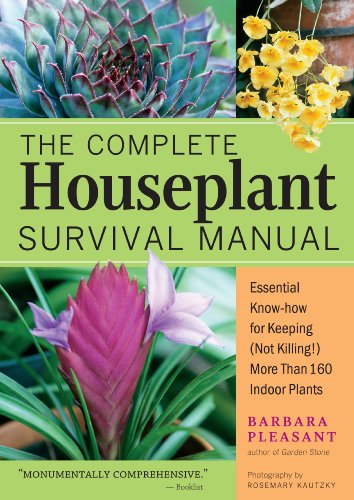
Barbara Pleasant's Complete Houseplant Survival Manual (Storey Publishing) is the houseplant reference most serious indoor gardeners reach for first. It covers 150+ species in depth, identification photos, growing conditions (light, humidity, temperature ranges), watering and fertilizing schedules, potting mixes, propagation methods, and a full troubleshooting section for each plant. Where most houseplant books give you a paragraph per species, Pleasant gives you a page or two with genuine specificity.
The book is organized by growth type (foliage plants, flowering plants, succulents, bulbs, edible herbs, orchids), which makes browsing useful even before you have a specific plant to look up. Each species entry includes a "Display" section suggesting which types of rooms suit the plant's light and humidity needs, practical for apartment growers making purchasing decisions. The troubleshooting tables ("Yellow leaves: causes and solutions," "Wilting: causes and solutions") are the most used pages in the book for long-term plant owners.
The Complete Houseplant Survival Manual by Barbara Pleasant
Covers monsteras, ferns, orchids, cacti, succulents, tropical foliage, and edible herbs indoors, not just the "easy" species. The troubleshooting tables at the back of each section are the highest-value part of the book for anyone dealing with a struggling plant.
Pros
- Depth per species, 1–2 pages vs. one paragraph elsewhere
- Practical troubleshooting tables for every major problem
- Covers propagation clearly for each species
- Good photography for in-store ID comparison
Cons
- 150 species, narrower coverage than encyclopedic references
- Some content dates to 2005 edition; newer cultivars not covered
Best Budget (Under $15): The Houseplant Expert
D.G. Hessayon's Houseplant Expert has sold millions of copies over 40 years for good reason: it covers 300+ houseplant species in a compact, affordable package. The illustrated format (hand-drawn botanical illustrations with color callouts rather than photographs) is polarizing, some readers find the illustrations clearer than photos for feature comparison, others miss the photographic realism. Either way, the ID information is accurate and the per-species care data is thorough for the price.
The Houseplant Expert by D.G. Hessayon
At this price, the Houseplant Expert is the single best-value plant reference available. Wide species coverage, reliable care data, and decades of proven usefulness. The illustration format works particularly well for identifying distinguishing features between closely related species, something photographs sometimes obscure with shadow and focus.
Pros
- 300+ species, widest coverage at this price point
- Detailed illustrations show distinguishing features clearly
- Care tables cover temperature, light, watering, feeding, propagation
- Under $15 new, excellent gift option
Cons
- Illustrations rather than photos, less useful for in-store ID
- Older edition; very recent cultivars not included
- UK origin, some variety names differ from US market
Best Wildflower Field Guide: National Audubon Society Field Guide
The National Audubon Society Field Guide to North American Wildflowers comes in Eastern and Western regional volumes covering 900+ species each. The photographic format organizes species by flower color, flip to the yellow-flower section, look for your shape, and find your plant within a few pages. This is the fastest workflow for casual field identification without prior botanical training. The species entries include habitat, range maps, bloom times, and brief notes on similar species, enough to confirm an ID or rule out a lookalike.
National Audubon Society Field Guide to North American Wildflowers
The gold standard for accessible wildflower ID in North America. Color-organized layout means no prior botanical knowledge is required, find your flower color, match the shape, confirm with the range map. Pairs well with an ID app: use the app in the field for a first ID, then confirm with the Audubon guide for the full species description and lookalike notes.
Pros
- 900+ species per volume, comprehensive regional coverage
- Color-organized layout works for beginners immediately
- Range maps confirm if species is present in your area
- Habitat and bloom time help narrow ID further
Cons
- Two separate volumes for E/W, buy the correct region
- Color organization means white/cream flowers span a huge section
- No edibility or toxicity information included
Best for Learning Plant Families: Botany in a Day
Thomas J. Elpel's Botany in a Day is not a field guide, it's a plant family pattern book, and that distinction matters. Instead of showing you 900 species to memorize, Elpel teaches you to recognize the structural patterns of 110 plant families worldwide. Once you know the Parsley family pattern (hollow stem, compound umbel flowers, aromatic seeds), you can identify any member, from fennel to Queen Anne's lace to poison hemlock, and know exactly which features distinguish them. This pattern-based approach is how professional botanists identify plants, and it's faster after the initial learning curve.
Botany in a Day by Thomas J. Elpel
The book every serious amateur botanist and wildcrafter eventually reads. Works as a second book after you've used a regional field guide and started noticing patterns, "why do these three plants in the carrot section all have hollow stems and umbel flowers?" Botany in a Day answers that question for 110 families. Also includes edibility patterns by family, which is extremely useful for foragers learning which families are generally safe to investigate further.
Pros
- Teaches transferable pattern recognition, speeds up all future IDs
- Worldwide scope, works on plants outside North America
- Edibility notes by family, valuable for foraging context
- 5th edition thoroughly revised and updated
Cons
- Line drawings, not photographic, harder for beginners
- Requires more study time than a flip-through field guide
- Better as a second book, not first
Best for Succulents & Cacti: Complete Book of Cacti & Succulents
DK's Complete Book of Cacti & Succulents by Terry Hewitt covers 300+ cacti and succulent species with full-color photographs and detailed cultivation notes. The species entries include natural habitat (important for replicating light, watering, and seasonal dormancy needs), propagation methods, and toxicity notes. For anyone growing a collection of succulents beyond the standard echeveria and aloe, this book covers the unusual genera, haworthias, gasteria, agave, pachyphytum, lithops, euphorbia, and the spine-covered cacti that look similar but behave very differently.
The Complete Book of Cacti & Succulents by Terry Hewitt (DK)
The standard reference for serious succulent growers. Particularly valuable for identifying the difference between similarly-shaped genera that need different care, like distinguishing a haworthia (shade-tolerant, frequent water) from an echeveria (bright light, infrequent water) that both look like compact rosettes at first glance.
Pros
- 300+ species, covers unusual genera most books skip
- Natural habitat information helps with care decisions
- DK photography quality, clear distinguishing features visible
- Propagation guide covers leaf cuttings, offsets, and seeds
Cons
- Taxonomy has shifted since publication, some names have changed
- New cultivars and hybrid colors not covered
- Not organized by care need, you need to look species up individually
Best for Weeds & Invasives: Weeds of North America
Dickinson and Royer's Weeds of North America (University of Chicago Press) is the most comprehensive weed ID reference available: 900+ weed species in color-photo format, with life cycle (annual/biennial/perennial), habitat, region, and control notes for each entry. Organized by plant family, it's the reference that professional land managers and gardeners serious about invasive species use when the weed in question doesn't appear in a generic garden guide. For anyone dealing with a persistent or unusual weed, particularly invasives like Japanese knotweed, kudzu, garlic mustard, or multiflora rose, this is the reference that identifies them definitively.
Weeds of North America by Dickinson & Royer
The professional reference for weed identification. Higher price point than other books on this list, but covers weeds that simply aren't in any other general-purpose guide. Particularly strong on agricultural weeds and invasives that are increasingly problematic in home gardens and natural areas. The control information is practical and current.
Pros
- 900+ species, definitively covers weeds other books miss
- Control notes per species, integrated management recommendations
- Life cycle data helps time control methods correctly
- Covers invasives comprehensively
Cons
- Higher price than most field guides
- Organized by family, requires some botanical knowledge to navigate efficiently
- More detail than a casual gardener needs
Best Tree & Shrub Guide: Audubon Field Guide to Trees
The National Audubon Society Field Guide to Trees covers 500+ tree and shrub species in photographic format, leaves, bark, fruit, seeds, and flowers each have separate photo sections so you can ID from whichever feature is in season. Organized by leaf shape rather than species family, the guide is accessible to people who don't know tree taxonomy but do know that the leaf in front of them is oval, lobed, or compound. Eastern and Western volumes cover their respective regions thoroughly. A must-have for anyone learning the trees in their neighborhood, yard, or local woods.
National Audubon Society Field Guide to Trees
The companion to the Audubon Wildflower guide for gardeners who want to identify what's in their yard, neighborhood, or local forest. The multi-feature photo format (leaf photos, bark photos, fruit photos all separately indexed) means you can make an ID from whatever part of the tree is accessible.
Pros
- Multi-feature photo organization, ID from leaf, bark, or fruit
- Covers native and common cultivated/ornamental trees
- Range maps confirm presence in your region
- Same approachable format as Audubon wildflower guides
Cons
- Two volumes, buy the correct region
- Less useful for shrubs specifically (mixed in with trees)
- Bark photos in black-and-white in some editions
Best Gift / Lifestyle: Urban Jungle, Living & Styling with Plants
Urban Jungle: Living and Styling with Plants by Igor Josifovic and Judith de Graaff is the book that inspired a generation of plant collectors. Less a technical ID reference and more a gorgeously photographed guide to living with plants indoors, it shows real homes, from Amsterdam apartments to New York lofts, filled with plant collections and explains how different species work in different light, humidity, and space conditions. The identification component comes through the styling context: you see a plant in a beautiful corner and learn its name, light needs, and care level. It's also the best plant gift for someone who's just becoming a plant person and doesn't yet know which reference they need.
Urban Jungle: Living & Styling with Plants
The book that made many people want more houseplants in the first place. If you're buying a gift for someone who just started collecting plants, or want inspiration for how to arrange a plant-filled living space, this is the book. The plant identification is contextual rather than encyclopedic, you learn species by seeing them in real rooms, which makes it memorable in a way that care tables don't.
Pros
- Beautiful photography, doubles as a coffee-table book
- Real homes with real plant collections, not studio shots
- Introduces 100+ species in styling context
- Excellent gift for new or aspiring plant collectors
Cons
- Not a technical reference, limited care depth per species
- Styling-heavy content; not for people who want only care information
- European focus, some species and variety names differ from US market
Essential Plant Care Accessories to Pair with Your Books
- SONKIR MS02 3-in-1 Soil Tester (moisture + light + pH), The practical companion to any houseplant reference book. Most houseplant books specify light level in lux ranges or describe conditions as "bright indirect", the SONKIR's light sensor translates your room's actual lux value so you know whether your corner matches the book's recommendation. The moisture meter stops the guessing that kills most houseplants.
- Perlite for potting mix amendment, Every serious houseplant book recommends amending potting mix with perlite for drainage. Buy a bag when you buy the book, you'll need it within the first repotting session.
- Plant stakes and labels for your collection, Once you start identifying plants properly, labeling them with the species name makes care consistency much easier. Stake labels that tolerate watering are better than paper tags.
- 10× hand loupe / jeweler's magnifier, Many plant ID features (hair types, gland dots, seed surfaces) are only visible under magnification. A $10 loupe transforms your ability to use technical field guides and confirm difficult IDs, standard equipment for any serious plant identifier.
- Self-watering planter for moisture-lovers, As your plant collection grows from identification to care, a sub-irrigation planter eliminates the most common cause of houseplant death (inconsistent watering). Worth buying alongside any comprehensive houseplant reference.
Frequently Asked Questions
What is the best plant identification book for beginners?
For complete beginners, the National Audubon Society Field Guides are the most approachable, photographic format, regional coverage, organized by color so no botanical knowledge is required. For houseplant beginners, the Houseplant Expert by Hessayon covers 300+ species at under $15 and is the most affordable starting reference.
Are plant identification books still useful when apps like Snap Plant exist?
Yes, books go much deeper than apps on care information, and they teach the structural patterns that make identification faster over time. Use the app for a quick field ID, then reach for the book for care depth, troubleshooting tables, propagation methods, and the "why" behind the identification. They complement rather than replace each other.
What is the difference between the National Audubon and Peterson field guide series?
Audubon uses full-color photographs organized by flower color, accessible to beginners immediately. Peterson guides use painted illustrations organized by structural features, more consistent cross-species comparison, preferred by many botanists for accuracy. Buy Audubon if you want a photo-based flip guide; consider the Peterson Field Guide to Wildflowers if you want to develop more precise botanical ID skills.
Is Botany in a Day actually useful for plant identification?
Botany in a Day teaches you to recognize 110 plant families by structural patterns, leaf arrangement, flower structure, seed type, so you can ID thousands of species by family before looking up the specific species. It's a second book, not a first: use a regional field guide to start making IDs, then add Botany in a Day when you start noticing patterns and want to understand them.
What plant identification books are best for toxic or dangerous plants?
For houseplants and pet safety, the ASPCA's free online toxic plant database is the most comprehensive source, covering 400+ species filtered by toxicity to cats, dogs, or horses. For North American wild plants, Weeds of North America by Dickinson and Royer includes toxicity notes in species descriptions. See also our guides to indoor plants safe for cats and plants toxic to dogs for pet-specific identification.